
People search for why do I get stomach aches at night in the dark, usually while it's happening. And the question underneath it is often sharper than the one they type: why now, when I was fine all day?
It's a fair question, and worth taking seriously rather than shrugging off. Below is what the health sources actually say about stress and the gut, what nobody can tell you about your particular night, and a few small things you can try tonight.
The workbook's daily log puts stress and symptoms on the same page, so you can look at the two side by side instead of trying to remember them at 2am.
Get the Mind-Gut Reset Workbook →Your Day Doesn't End When You Stop Moving
Think about what a normal day asks of you. You brace for a conversation. You hold a worry about money, a child, a diagnosis, a parent. You absorb something that annoyed you and say nothing, because saying something would have cost more than it was worth. By the time you turn the light off, none of it has been resolved. It is simply later.
Your gut and your brain are not separate departments. Crohn's & Colitis UK describes the gut-brain axis as a direct, two-way link between the two, with communication running through nerve signals, hormones and other chemicals. They are honest about the limits, too: it is not clear exactly how that link works. What they do say plainly is that stress can have a negative effect on gut symptoms, and that stress can have physical effects generally, including sleep problems.
The NHS says the same thing from the other side. It lists stress and anxiety among the things that can trigger IBS symptoms, alongside alcohol, caffeine and certain foods. None of that means your pain is invented. It means pressure and digestion run on connected wiring.
So it is fair to ask whether your day is still with you when you lie down, and whether that is worth doing something about.
What Is Different About the Dark
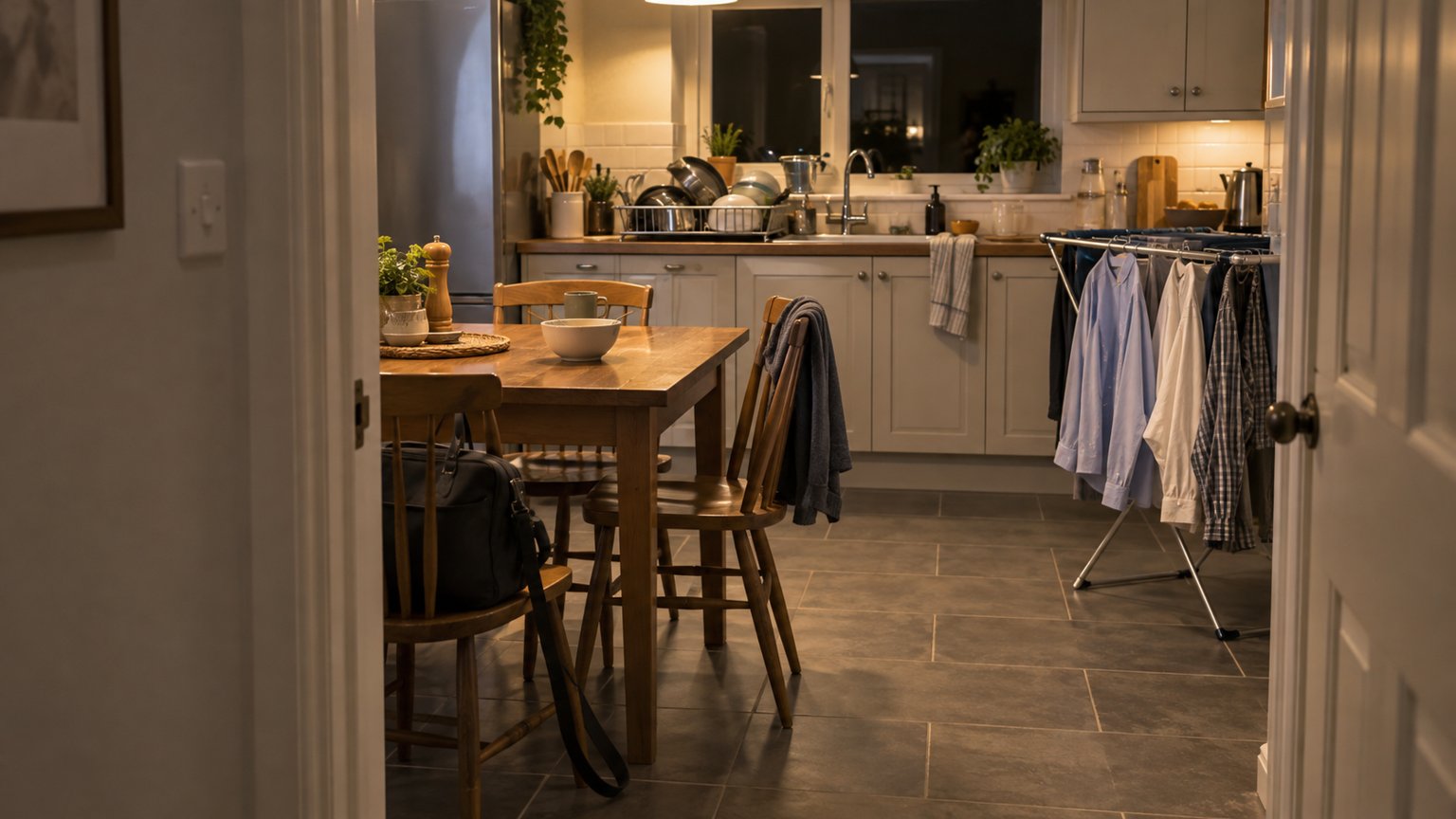
Nobody can tell you from a distance why your gut is quiet at 3pm and sore at 11pm. What can be described honestly is how the end of the day differs from the rest of it.
- The room is quiet. All day there is traffic, talking, screens and tasks. In a dark bedroom there is none of that. Whether the quiet is why the ache seems louder is not something a study can tell you about your own body — but the quiet is real, and so is the pain.
- Bedtime is a change of gear. You spend the day upright, moving and busy. Then, within a few minutes, you are flat, still and unoccupied, with nothing left to do but notice.
- The unfinished thinking. If bed is where you go back over the day — what you should have said, what happens tomorrow, what the results might mean — that is worth knowing about yourself. Crohn's & Colitis UK point out that stress has physical effects, not only emotional ones, and that it can make gut symptoms worse.
Then a fourth thing can join in: worry about the pain itself. Is this going to be a whole night? Will I be useless tomorrow? Writing for people with Crohn's or colitis, the same charity describes how someone with both a mental health problem and a gut condition can end up in a cycle, with each one making the other worse. The pain is real. The worry about it is understandable. And a cycle, unlike a verdict, has more than one place you can take hold of it.
What Comes After the Mind
Once you have seen the nervous-system side, the ordinary practical things are worth having too — as support, not as the whole explanation.
- If you have IBS, the NHS lists alcohol, caffeine, and spicy or fatty food among the things that can trigger symptoms. An evening that involves several of them is worth noticing.
- Beyond a list like that, nobody can tell you from a distance what your own gut does with a late dinner or an afternoon coffee, which is a good reason to keep a written record of your own evenings.
- And change one thing at a time. Changing five things at once tells you nothing about which one mattered.
None of these explain why the ache waits for the quiet. They are the support act, not the headline. And the last section of this post is about when night-time pain should be looked at by a doctor rather than worked on at home.

Ending the Day Before You Lie Down
The aim isn't a perfect bedtime routine. It's to put the day down somewhere before you lie down with it.
- Close the day on paper, not in bed. Ten minutes before you go up, write down what is unfinished and what tomorrow needs. Not as a treatment for anything — just so the list is somewhere other than your head while you are lying in the dark.
- Learn one relaxation technique and practise it. Crohn's & Colitis UK suggest relaxation techniques for stress and anxiety, saying they may help to reduce anxiety, pain and stress levels in people with Crohn's or colitis, and they point readers to the mental health charity Mind for relaxation tips. Which technique you pick is up to you. Pick one you can picture yourself doing on an ordinary Tuesday, and practise it on calm evenings rather than saving it for a bad night.
- Leave a gap between the day and the dark. Going straight from a screen or a difficult conversation to lights-out gives the day no gap at all. This is not a claim about twenty minutes fixing anything — it is simply room to put the day down before you lie down.
- Take the comfort. A hot water bottle or a warm shower before bed is not treatment for anything. It is comfort, and there is no prize for going without it.
- If the pain wakes you, you are allowed to move. Sitting up, sipping some water, walking about the room for a few minutes — none of it is giving in, and there is no prize for lying rigid until morning.
There is also real help for the gut-brain side of this. The NHS notes that if you have had IBS for a long time and other treatments have not helped, a GP may refer you for a talking therapy such as CBT, which can help if stress or anxiety is triggering your symptoms. Gut-directed hypnotherapy has been studied specifically for the gut: a 2025 systematic review and meta-analysis of 12 studies in 1,158 people with IBS concluded it may improve overall IBS symptoms and improved pain compared with other standard approaches — while noting the studies varied widely, so it is not a guaranteed result for any one person. The Rome Foundation keeps an overview of these brain-gut therapies. All of it sits alongside your doctor's care rather than replacing it, and any change to medication belongs in a conversation with the doctor who prescribed it.
Two lines a night — how the day felt, how the night went — is the simplest place to start. That log, a short daily calming practice and a wind-down that actually ends the day are all in the Mind-Gut Reset Workbook.
Get the Mind-Gut Reset Workbook →When to Get It Checked
There is a point where this stops being a question about bedtime routines and belongs with a doctor. The NHS says to see a GP if you think you might have IBS and have had symptoms for over four weeks, and to ask for an urgent GP appointment or NHS 111 advice if you have lost a lot of weight for no reason, are bleeding from your bottom or have bloody diarrhoea, or you find a hard lump or swelling in your tummy.
Night-time symptoms matter to doctors in their own right. A review of how suspected functional bowel disorders are assessed lists nocturnal symptoms among the most important "alarm symptoms" — the ones that mean further investigation is needed before anyone settles on a diagnosis, alongside bleeding, documented weight loss, symptoms starting after the age of 50 and a family history of bowel cancer. So: stomach pain that keeps waking you at night should be taken to a doctor rather than managed alone at home, whatever you suspect is behind it. Nothing in this post is a reason to wait. If you already live with Crohn's, ulcerative colitis or IBS, tell your IBD or GP team that your nights have changed; a doctor would far rather hear about it early than late.

It Can Get Quieter
Imagine Marta, who had six months of stomach aches that started at bedtime. She had already cut out dairy, then bread, then anything after seven, and the nights carried on regardless. What she hadn't noticed was that the worst ones followed the days she'd spent braced — a difficult meeting, a call with her mother, a message she reread eleven times.
She started writing two lines before bed: one about the day, one about the night. Within three weeks she could see the connection on the page, and the bad nights stopped feeling random. She moved her dinner earlier, and she spent five minutes each evening with the lamp on, breathing slowly, before the light went off. Her nights are still her nights. What changed first was the fear that arrived with the ache — here we go, another one gone — and having something to do at 11pm other than wait.
Nothing here is a promise about how quickly anything changes. But feeling much better is possible, help exists for the gut-brain side of it, and giving the day somewhere to land before you lie down is one part you can reach yourself, tonight, without waiting for anything.
What is your body still holding at 11pm that nobody asked you to carry all day?
If your nights are where the day finally shows up, the Mind-Gut Reset Workbook gives you 30 days of simple tracking and calming practice to work through, used alongside the care your doctor provides.
Get the Mind-Gut Reset Workbook →