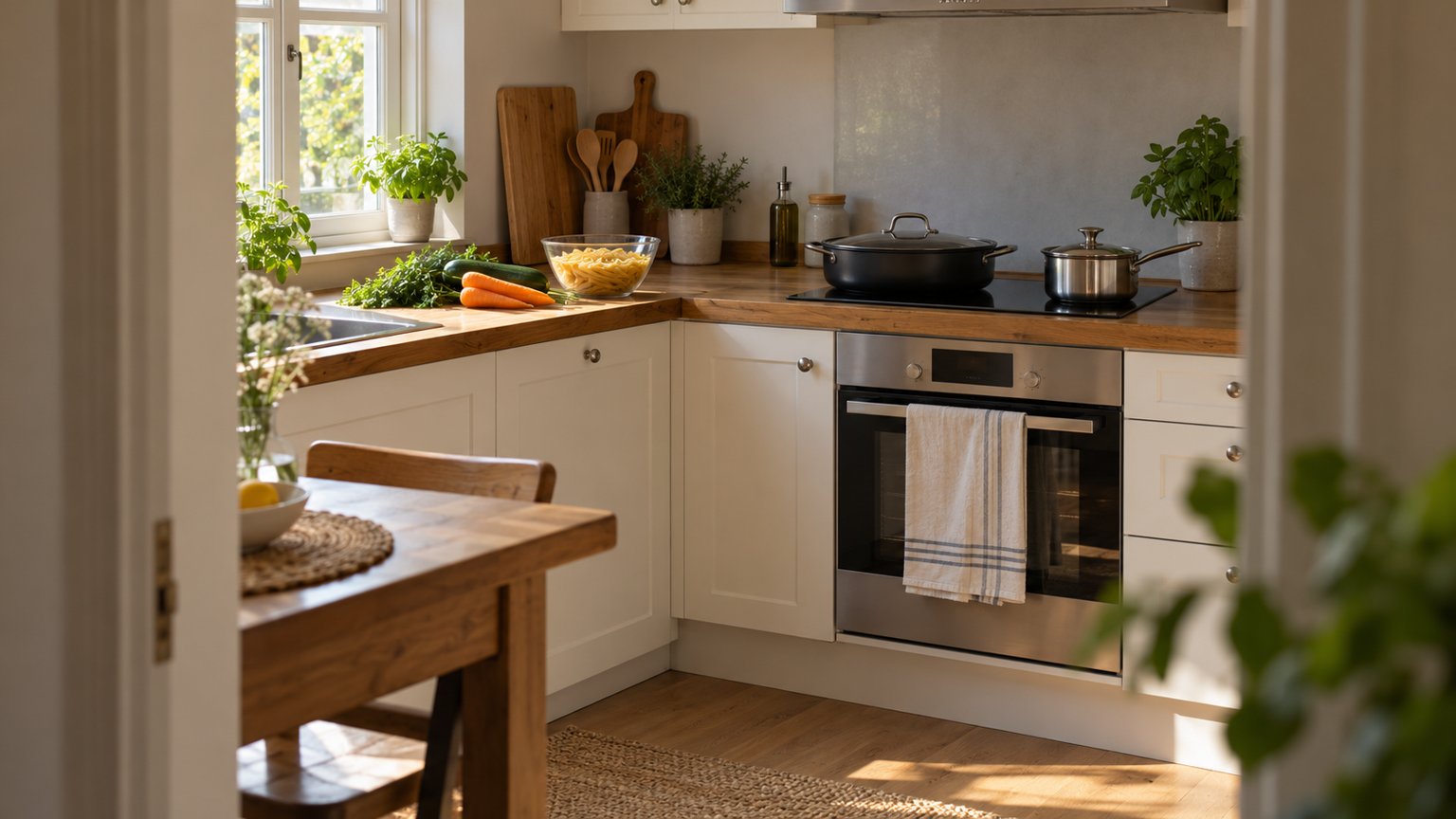
It's Saturday afternoon. For three weeks you've lived on plain rice, dry toast and weak tea, and for the last few days your gut has finally been quieter. Tonight you want to cook the dinner you used to make every week: carrots, courgette, fresh herbs, a bit of pasta. The ingredients are on the counter. The pan is on the hob.
And you're standing there not starting. Next to the hob, there's a small pot of plain rice you cooked "just in case". Your mind is replaying the worst night of the flare. A voice says: Is it worth it? What if this is the thing that sets it off again?
If you live with Crohn's disease or ulcerative colitis, you've probably typed something like "Crohn's flare up foods" into a search bar, hoping for a clear list. This post won't pretend to give you one. It's about the part a food list leaves out: why the first normal meal after a flare can feel so frightening, what that fear can do to your gut, and how to get back to food you enjoy with less dread.
If coming back to food after a flare has turned into a fear of its own, the workbook has a food re-test plan and a safe-list check you can work through calmly, alongside your IBD team's advice.
Get the Mind-Gut Reset Workbook →Why Your Mind Stays in the Flare After Your Gut Starts to Settle
A flare doesn't only happen in your bowel. It happens in your memory too. The bad days, the rushing, the plans you cancelled: your mind keeps all of it, and it links it to whatever you ate around that time.
Crohn's & Colitis UK puts it simply: you may feel that certain foods trigger your symptoms, which can put you off eating, and this can be upsetting if you usually enjoy food. The same guide says you may worry about possible symptoms and the fear associated with experiencing them.
That's what is happening at the kitchen counter. Your gut may be settling, but your mind is still on guard. It's trying to protect you, and it uses the only evidence it has: the last time things went badly, food was involved.
It also helps to know why it's so strong right now. Crohn's & Colitis UK says you are more likely to have anxiety problems when your condition is active and you are dealing with symptoms. The weeks around a flare are not a sign that you're weak. They're a tender time.

What the Fear Can Do at the Table
This is the part worth reading slowly, because it's where your thoughts and your gut meet.
Crohn's & Colitis UK describes the gut-brain axis as a direct two-way link between the gut and the brain, carried by nerve signals, hormones and other chemicals. So the fear you bring to the plate isn't sealed off from your gut. It's on the same line.
The guide says anxiety can make gut symptoms worse, and that there's some evidence that stress might make your Crohn's or Colitis symptoms worse and increase the risk of a flare-up. A 2022 systematic review of 38 studies with 4,757 people with IBD found that psychological stress appears to come before IBD flares, though the authors say it is still unclear how stress is best managed.
Please read that carefully. It doesn't mean fear caused your Crohn's or colitis, and it doesn't mean one nervous dinner will start a new flare. It means the tension you eat with is part of the picture, alongside your treatment, and it's a part you can work on.
There's one more trap. Anxiety has body symptoms of its own, and Crohn's & Colitis UK notes that some of the symptoms may be like those of Crohn's or Colitis. So you eat the meal, you feel a flutter of nerves, and your mind reads it as proof: See, the courgette did it. The next week, the list of foods you trust gets a little shorter.
When the Safe List Keeps Shrinking
Eating more simply for a while can make sense, and your IBD team may suggest it. The problem comes when fear, not your gut, decides how long "a while" lasts.
Crohn's & Colitis UK explains that food worries can lead to behaviours like binge eating, skipping meals, or restricting food, which means you may risk not getting enough nutrients from food, which can complicate your condition. For some people it goes further, until they will only eat a narrow range of 'safe' foods. The guide says nearly 1 in 5 people with IBD have some symptoms of ARFID, the name for this pattern.
If the rice-and-toast weeks are turning into rice-and-toast months, that's not a failure. It's a sign to ask for help. Talk to your IBD team; they may be able to refer you to a dietitian, who can support you to improve your nutrition.

What Can Help, Starting With the Mind
The fear was built one bad night at a time. It can ease the same way, one calmer meal at a time.
- Calm your body before you cook. Relaxation techniques may help to reduce anxiety, pain and stress levels and improve your mood if you have Crohn's or colitis. A few minutes of slow breathing, with the breath out longer than the breath in, is an easy place to start. Do it before you start cooking, not only once the worry has taken hold.
- Stay with this meal, not the last flare. Mindfulness is about noticing when we are stuck in patterns of worrying about the past or future, and Crohn's & Colitis UK says it can be useful when you're dealing with a flare-up. When the replay starts, name it: "That was then." Then look at what's actually on your plate.
- Write down how you feel, not only what you ate. Crohn's & Colitis UK says even just keeping notes of how you feel on your phone may help you to spot patterns. A list of foods on its own can't show you that the "bad" meal was also the one you ate while dreading it.
- Make your plan with your team, so it isn't fear's plan. Ask your IBD team or a dietitian how and when to bring foods back. Then you're following a plan you agreed on a calm day, instead of guessing at the counter.
- Ask about talking therapy. CBT aims to help you explore and change unhelpful patterns of thinking and behaviour, and ACT can help you to engage with different situations that you might normally avoid if you're worried about symptoms. There is evidence that people with Crohn's or colitis who get psychological support have improvements in anxiety and depression and are more able to cope with symptoms, though the guide is honest that more evidence is needed to say whether psychological therapies can also improve gut symptoms.
- Take it one day at a time. Sharon, who lives with colitis, told Crohn's & Colitis UK: "Being in the present moment and taking it day by day really helps me to reduce anxiety." You don't have to trust every food again this week. Just tonight's.
Working on the fear is worth it for your gut, too. Crohn's & Colitis UK says finding ways to manage your anxiety can reduce your chances of having a flare-up and needing steroid treatment.
The workbook has a short daily calming practice with a 21-day tracker, plus a food re-test plan you can fill in before the next meal that scares you.
Get the Mind-Gut Reset Workbook →Food and Treatment: The Support Around It
What you eat still matters. It just works best as support for a calmer mind, not as a list of rules written by fear. Your IBD team and a dietitian know your condition, your treatment and your history, which makes them the right people to help you decide what to eat as a flare settles.
Your treatment is part of looking after your mind, too. The guide says keeping gut inflammation under control may help to improve your mental health, and that your Crohn's or colitis medicines can help with this. It also warns that not sticking to your usual treatments can lead to more frequent flare-ups. Any change to your medication is a decision to make with your IBD team, never alone.

The Dinner, a Few Weeks Later
Imagine Tomas, who has had Crohn's for eight years. After his last flare, he lived on the same three foods for two months. Every time he thought about cooking his favourite pasta, he remembered the worst night of the flare, and made rice instead.
What changed wasn't a brave leap. He told his IBD nurse how small his diet had become, and she referred him to a dietitian, who helped him plan which foods to bring back and when. He started doing five minutes of slow breathing on the back step before cooking. He began writing down how tense he felt before each meal, not just what was on the plate, and noticed that his worst evenings were often the ones he'd eaten while dreading it. Some meals still didn't sit well. But more of them did.
His Crohn's didn't go away. But food stopped being the enemy. And as Crohn's & Colitis UK reminds readers, your life is not just about your Crohn's or Colitis.
The vegetables are still on the counter. You don't have to cook them tonight. But one day soon, you can stand in that kitchen, breathe out slowly, and make the meal you love with more calm than fear. Feeling much better around food again is possible.
What is one food you miss, and what would make trying it again feel a little safer?
If your plate has been getting smaller since your last flare, the Mind-Gut Reset Workbook gives you 30 days of simple tracking and calming practice, used alongside the care your IBD team provides.
Get the Mind-Gut Reset Workbook →