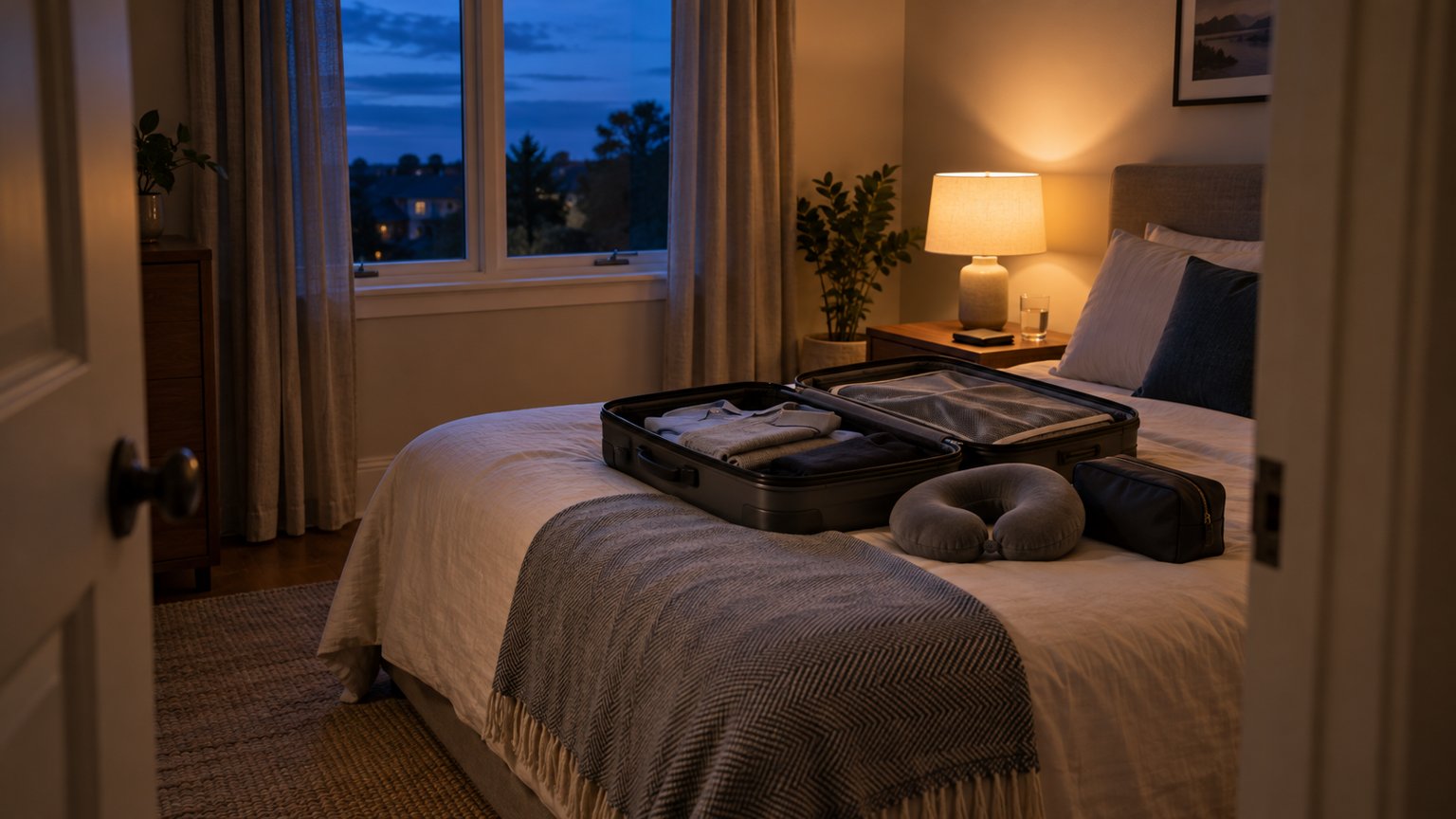
It's a Tuesday evening, three weeks before the trip. The flights are booked and the hotel is paid for. Your friend has already sent a message about which restaurants to try. And you're sitting on the edge of the bed with the airline's seat map open again, for the fifth time this week, checking how far row 23 is from the toilets.
You know the answer. You checked yesterday. But your mind keeps going back, adding new questions: What if the seatbelt sign stays on? What if there's a queue? What if it starts on the way to the airport? The trip hasn't started, and your gut already feels tight.
If you live with Crohn's disease or ulcerative colitis, you may have typed "travelling with Crohn's" into a search bar hoping for a packing list. This post is about the part a packing list leaves out: why the worry about a trip can start weeks before you leave, what that worry can do to your gut, and how to travel with more calm and less dread.
If trips have turned into weeks of worry, the workbook has a plan for eating and coping away from home that you can fill in before you go, alongside your IBD team's advice.
Get the Mind-Gut Reset Workbook →Why Your Mind Starts the Trip Before You Do
At home, you know where everything is. Your own bathroom, your own food, your own bed. A trip takes all of that away at once, and your mind knows it.
Crohn's & Colitis UK says that when you live with Crohn's or colitis, you may worry about possible symptoms and the fear associated with experiencing them. One person living with Crohn's, Ally, described it like this: “Going out can sometimes feel overwhelming and give you so much anxiety, always wondering where the toilet is, or worrying will I suddenly feel ill when I’m out.”
A trip is "going out" stretched over days, in a place you don't know. So the worry doesn't wait for the airport. It starts the moment you book, because your mind is trying to solve every problem in advance. The seat map, the route to the gate, the length of the taxi ride: each one feels like something you must get right to stay safe.
The same guide explains that these anxieties may just appear in certain situations. For example, you might feel anxious if you do not have easy access to a toilet, but then return to normal when you reach home. That's worth knowing. The tension you feel before a trip is not proof that something is wrong with your gut today. It's often your mind reacting to being far from home.

What the Worry Can Do to Your Gut
This is the part worth reading slowly, because it's where your thoughts and your gut meet.
Crohn's & Colitis UK describes the gut-brain axis as a direct two-way link between the gut and the brain, carried by nerve signals, hormones and other chemicals. So the weeks of worry before a trip aren't happening somewhere separate from your gut. They're on the same line.
The guide says anxiety can make gut symptoms worse, and that there’s some evidence that stress might make your Crohn’s or Colitis symptoms worse and increase the risk of a flare-up. A 2022 systematic review of 38 studies with 4,757 people with IBD found that psychological stress appears to come before IBD flares, though the authors say it is still unclear how stress is best managed.
Please read that carefully. It doesn't mean worry caused your Crohn's or colitis, and it doesn't mean one nervous flight will start a flare. It means the tension you carry into a trip is part of the picture, alongside your treatment, and it's a part you can work on.
There's one more trap. Anxiety has body symptoms of its own, and Crohn's & Colitis UK notes that some of the symptoms may be like those of Crohn’s or Colitis. So on the morning you leave, you feel a churn in your stomach, and your mind reads it as the start of a flare. That makes you more anxious, which makes the churn stronger.
When Trips Start to Shrink
After a hard journey, it's natural to want the next one to be easier. Shorter. Closer. Maybe a train instead of a plane, or a weekend instead of a week. Sometimes that's a sensible choice. The problem comes when fear, not your gut, starts making every travel decision.
One trip gets cancelled. Then the wedding abroad gets a polite "sorry, we can't make it". Then you stop being asked. If that's happening, it's not a failure. It's a sign that the worry has grown bigger than the trips, and that's something you can get help with.

What Can Help, Starting With the Mind
The worry was built one hard journey at a time. It can ease the same way, one calmer trip at a time.
- Plan once, then put the plan down. Write your travel plan on a calm day: where you'll sit, what you'll pack, what you'll do if you need a toilet fast. Then close the seat map. Checking it again doesn't add safety. It just feeds the worry.
- Calm your body before the hard moments. Relaxation techniques may help to reduce anxiety, pain and stress levels and improve your mood if you have Crohn's or colitis. A few minutes of slow breathing, with the breath out longer than the breath in, is an easy place to start. Try it the night before, in the taxi and at the gate, not only once the worry has taken hold.
- Notice when your mind is living in the last bad trip. Mindfulness is about noticing when we are stuck in patterns of worrying about the past or future, and Crohn's & Colitis UK says it can be helpful for Crohn’s and Colitis, as a way of developing skills for managing stress. When the replay starts, name it: "That was then." Then look at where you actually are.
- Tell the people you're travelling with. Talking can also help family, friends or colleagues to understand what you’re going through. A friend who knows can ask for the aisle seat with you, or wait without questions. You no longer have to hide it and plan at the same time.
- Make a plan for urgent toilet access. If you live in the UK, Crohn's & Colitis UK members can get a Can’t Wait Card and a RADAR key to unlock accessible toilets. The card will help when you need urgent access to the toilet when you are out. Knowing you have a plan can quiet the "what if" voice.
- Give yourself permission to change plans. Crohn's & Colitis UK's advice is to accept that you might have to change plans at times – and don’t feel guilty about it. A trip with a rest afternoon built in is still a trip.
- Ask about talking therapy. CBT aims to help you explore and change unhelpful patterns of thinking and behaviour, and it can help with changing behaviours, like avoiding going out or isolating yourself. ACT can help you to engage with different situations that you might normally avoid if you’re worried about symptoms. There is evidence that people with Crohn's or colitis who get psychological support have improvements in anxiety and depression and are more able to cope with symptoms, though the guide is honest that more evidence is needed to say whether psychological therapies can also improve gut symptoms.
Working on the worry is worth it for your gut, too. Crohn's & Colitis UK says finding ways to manage your anxiety can reduce your chances of having a flare-up and needing steroid treatment.
The workbook has a short daily calming practice with a 21-day tracker, plus a page for eating and coping away from home that you can fill in before your next trip.
Get the Mind-Gut Reset Workbook →Your Treatment Travels With You
Packing, food and timing still matter. They just work best as support for a calmer mind, not as a list of rules written by fear. Before a long trip, ask your IBD team what to plan for while you're away, including your medicines and what to do if symptoms change.
Your treatment is part of looking after your mind, too. Crohn's & Colitis UK says keeping gut inflammation under control may help to improve your mental health, and that your Crohn's or colitis medicines can help with this. It also warns that not sticking to your usual treatments can lead to more frequent flare-ups. Any change to your medication is a decision to make with your IBD team, never alone.

The Trip, a Year Later
Imagine Laura, who has had ulcerative colitis for six years. For a long time, every holiday started with two weeks of dread. She checked seat maps every night, barely ate on travel days, and spent the first evening of each trip too tense to enjoy anything. After one bad journey, she stopped flying altogether.
What changed wasn't a brave leap. She told her IBD nurse how much the trips scared her, and asked about talking therapy. She wrote one travel plan and let herself look at it only once a day. She started doing five minutes of slow breathing the night before travelling, and again at the gate. She told her sister, who now asks for the aisle seat without being asked. Some journeys were still uncomfortable. But more of them were fine, and she noticed the dread starting later each time.
Her colitis didn't go away. But the trips came back. And as Crohn's & Colitis UK reminds readers, your life is not just about your Crohn’s or Colitis.
The seat map is still open on your phone. You can close it tonight. One day soon, you can sit at the gate, breathe out slowly, and look forward to where you're going with more calm than fear. Feeling much better about travel is possible.
What is one place you'd love to go, and what would make the journey there feel a little safer?
If the worry about travel has started to keep you at home, the Mind-Gut Reset Workbook gives you 30 days of simple tracking and calming practice, used alongside the care your IBD team provides.
Get the Mind-Gut Reset Workbook →