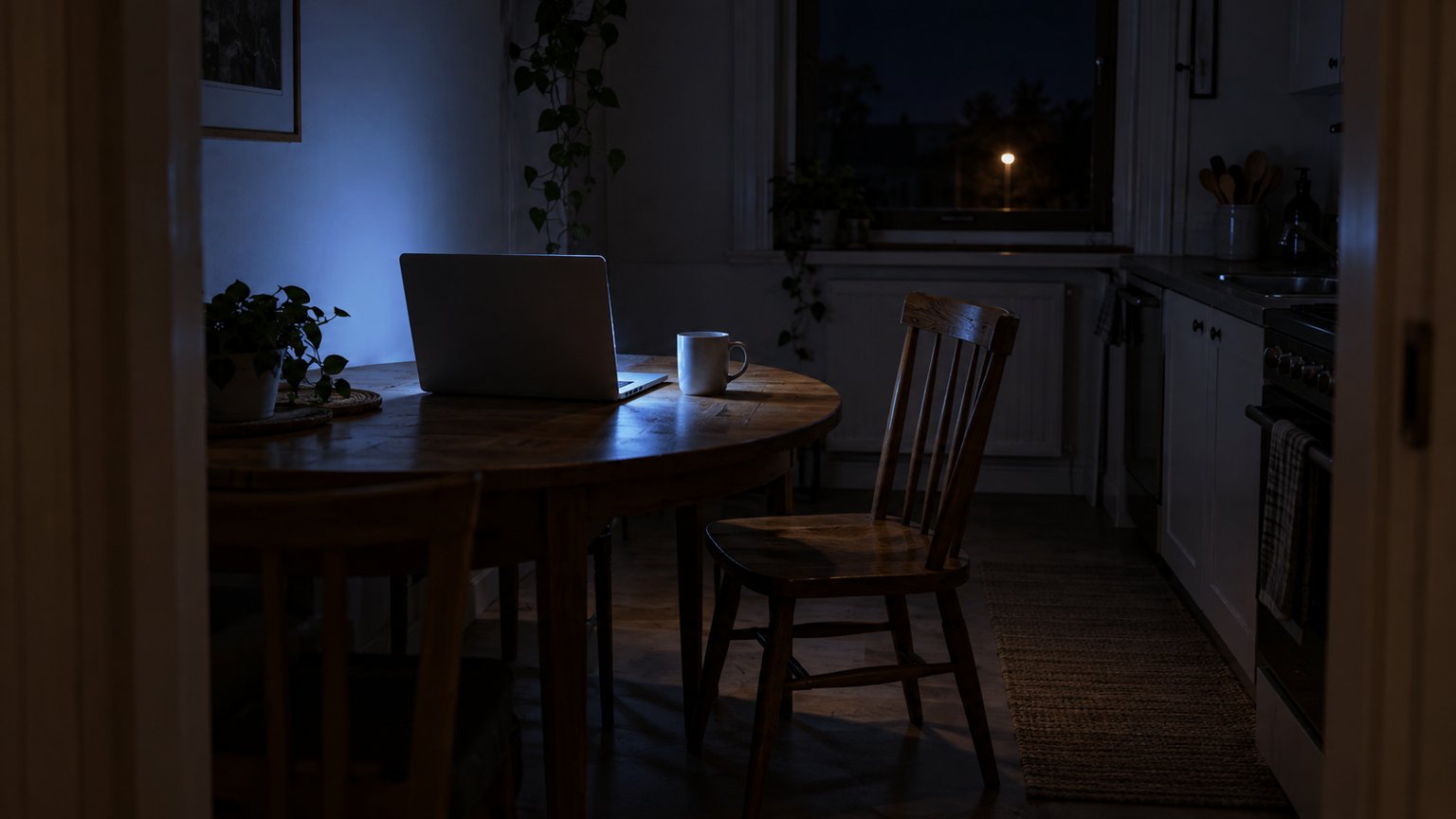
It's ten past two in the morning. You went to bed fine. Then you rolled onto your side and felt it: a dull ache low on the left, somewhere you don't usually feel anything.
You lie still and wait for it to go. It doesn't, quite. So you reach for your phone, just to check. One search becomes five. By three o'clock you've read about things you can't pronounce, you've compared your ache to strangers' stories on a forum, and your heart is going faster than it was when you lay down. And now your stomach really does hurt.
If you've ever typed "health anxiety bowel" or "is it IBS or something worse" into a search bar in the middle of the night, this post is for you. It's about why an unpredictable gut and a worried mind keep setting each other off, and what can help, starting with the mind.
If new symptoms keep sending you down a worry spiral, the workbook has a 14-day log that puts your gut, your stress and your sleep side by side, so you can see what your patterns really look like instead of guessing at 2am.
Get the Mind-Gut Reset Workbook →Why IBS Makes Worry So Easy
IBS doesn't behave the same way every day. The NHS says its symptoms tend to come and go over time, and can last for days, weeks or months at a time. It also says IBS flare-ups can happen for no obvious reason.
Put those two things together and you have the perfect ground for worry. When your gut changes without warning, your mind tries to find the reason. And when there's no clear reason, a frightened mind is very good at filling the gap with the worst one it can think of.
It's not that you're dramatic. You live in a body that keeps surprising you. Wanting to know what's going on is a normal response to that. The trouble starts when the checking stops bringing relief and starts bringing more fear.

How the Worry Can Feed the Gut
Here is the part that makes the loop so hard to break. The NHS names stress and anxiety among the things that can trigger IBS symptoms. So the fear you feel at 2am isn't only in your head. It can stir up the very gut you're worrying about.
Think about what that night actually looked like. A small ache. Then fear. Then a racing heart, tight shoulders, no sleep. Then, by morning, a gut that feels worse than it did at midnight. To a worried mind, that looks like proof: "See, it's getting worse." But some of that worsening may have come from the worry itself.
The NHS also says the exact cause of IBS is unknown, but that it has been linked to things like oversensitivity in your gut and stress. A gut that's already sensitive, watched closely by a mind that's already afraid, can turn a small signal into a long night.
This doesn't mean your symptoms are imaginary. They're real. It means your mind and your gut are talking to each other, and right now the conversation is mostly alarm.
When a Doctor Should Look at It
Not every worry is health anxiety. Some changes really do need checking, and knowing which ones can actually make the rest easier to let go of.
The NHS says to ask for an urgent GP appointment or get help from 111 if you have lost a lot of weight for no reason, are bleeding from your bottom or have bloody diarrhoea, or find a hard lump or swelling in your tummy. It says these could be signs of something more serious. If you think you might have IBS and have had symptoms for over four weeks, the NHS says a GP can check for IBS and do some tests to rule out other problems.
So here's a fair deal to make with yourself. If something new appears, or something on that list shows up, you book the appointment. You don't talk yourself out of it. But you don't let a search engine at 2am do the doctor's job either. The appointment is where the question gets answered. The middle of the night is not.

What Can Help, Starting With the Mind
The goal isn't to stop caring about your health. It's to give the worry somewhere better to go than a search bar.
- Make a "morning question" note. When a new twinge shows up at night, write it down in one line: where it is, what it feels like, what time it started. Then tell yourself the question is saved for the morning. That way the worry has a place to wait until you can do something useful with it.
- Notice the pull to check. Before you open the search bar, pause and ask: "Am I looking for information, or am I looking for reassurance?" Then think back: did the last late-night search actually leave you calmer? Naming the pull gives you a moment to choose.
- Track for a doctor, not for a panic. A short daily note of your symptoms and how stressed you felt gives your GP something useful. It also lets you see, over weeks, how often a scary twinge came and went on its own.
- Ask about talking therapy. The NHS says a GP may refer you for a talking therapy such as cognitive behavioural therapy (CBT), which can help if stress or anxiety is triggering your symptoms and can also help you cope with your condition better. In England you can also refer yourself directly to an NHS talking therapies service, which offers therapies like CBT for stress and anxiety.
- Consider gut-directed hypnotherapy. A 2025 review of 12 studies with 1,158 people with IBS found that gut-directed hypnotherapy may improve overall IBS symptoms, and that it improved pain more than the comparison groups. It isn't a treatment for health anxiety itself, and it isn't a cure. But a gut that hurts less gives a worried mind less to grab onto.
The Rome Foundation, an international group of gut specialists, says there is now adequate evidence to support the integration of brain-gut psychotherapies into gastroenterology care, and that these therapies are believed to help with gut symptoms as well as improve coping and quality of life. Working on the worry isn't a sign that your gut problem is "all in your head". It's part of looking after it.
The workbook includes a flare first-aid page and a short daily calming practice with a 21-day tracker, so the next scary night comes with a plan instead of a search bar.
Get the Mind-Gut Reset Workbook →Medicine, Food and Sleep as Support
Medicine can be part of the picture too. The NHS says that if pharmacy medicines haven't helped, a GP may prescribe amitriptyline or citalopram. These are antidepressants, but they can also help ease IBS symptoms. Whether a medicine is right for you, and any change to what you already take, is something to decide together with your GP, never on your own.
Food matters as well. The NHS lists alcohol, caffeine and certain foods, such as spicy or fatty food among possible triggers, and says a GP may refer you to an NHS dietitian if general changes haven't helped. Just keep food in its place: support for a calmer system, not a new list of things to be afraid of. And if late-night searching has become a habit, charging your phone outside the bedroom is a small change worth trying.

A Few Months Later
Imagine Marta, who has had IBS for eight years. For a long stretch, every new ache meant a night of searching. She'd go to work the next day exhausted, sure that this time it was something serious, and her gut would be worse all week.
What helped wasn't one big answer. She went to her GP and talked about the new symptoms, and the things worth checking were checked. Then she talked about the nights. She referred herself to an NHS talking therapies service and started working on the worry itself. She kept a small notebook by the bed for "morning questions", and moved her phone charger to the kitchen.
She still has IBS. She still gets the odd twinge that makes her stomach drop. But now she writes it down, books an appointment if it's something new, and goes back to sleep more often than not. The ache doesn't get to run the whole night any more.
Your worry makes sense. You live with a gut that doesn't always explain itself. But the loop can loosen, and feeling much calmer in your own body is possible.
The last time a twinge sent you searching, what were you really hoping to find?
If health worries and IBS keep feeding each other, the Mind-Gut Reset Workbook gives you 30 days of simple tracking and calming practice, used alongside the care your GP provides.
Get the Mind-Gut Reset Workbook →